Owning the State Lifecycle When the API You Depend on Drives the Workflow
Stateful simulators let you test the API-driven transitions your app can only react to.
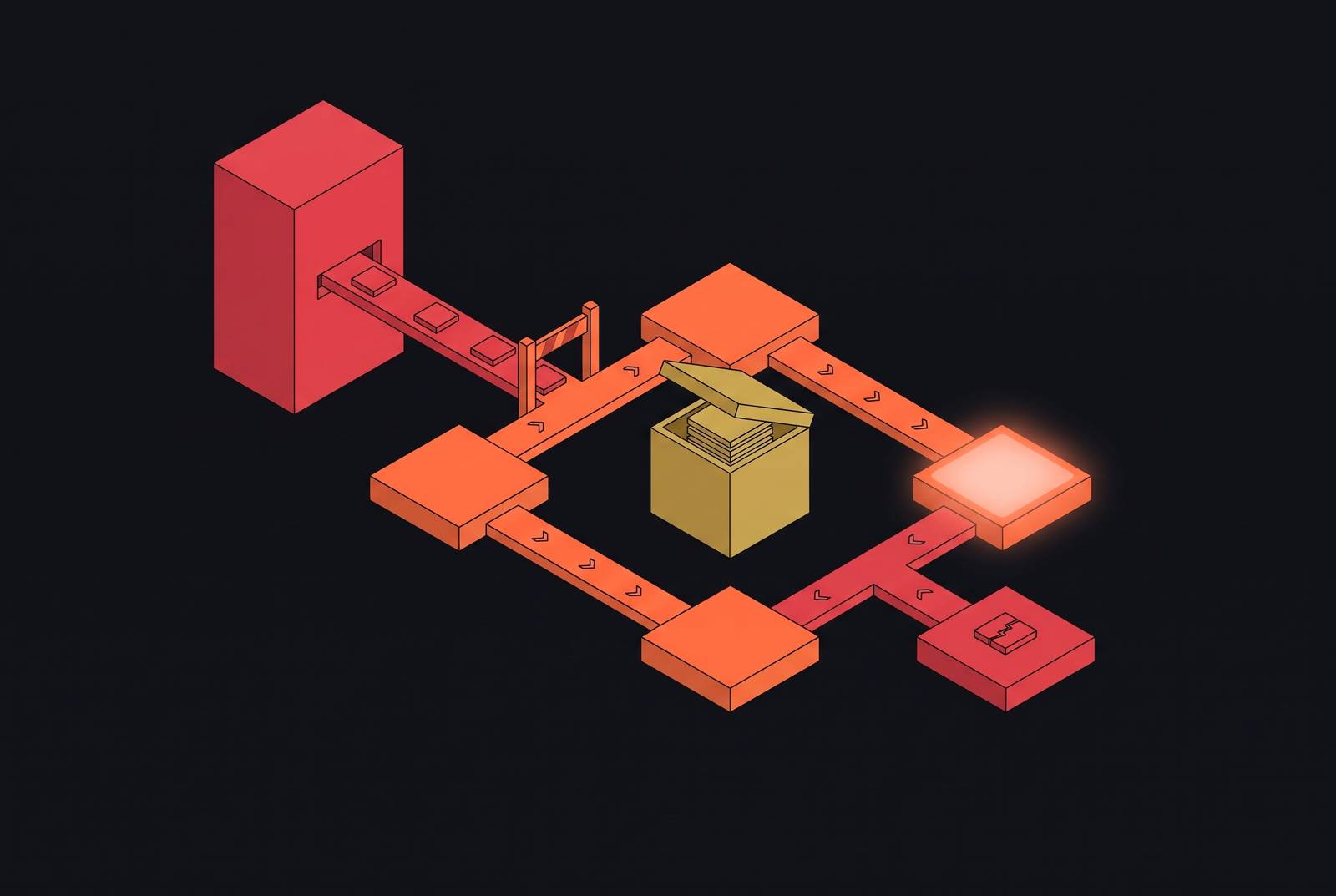
Integration testing against stateful APIs requires a simulator that remembers prior calls, enforces transitions, and reproduces webhook delivery and failure paths without hitting production. Tests must exercise complete sequences. When an external API drives the workflow, owning the state lifecycle means having a clear model of the transitions your application must handle and testing that model as the API changes.
Why API-driven workflows invert the normal state ownership model
A checkout can appear to follow a familiar ownership model. Your code advances the order status, and Stripe confirms payment. But when payment requires later processing, the synchronous response no longer completes the workflow. A subsequent webhook supplies the transition your application needs before it can proceed. The API is now the state machine, and your application is a reactor.
That inversion appears in several related forms. Webhook choreography makes the application respond to externally triggered changes, while asynchronous fulfillment leaves a gap between the request that opens a workflow and the event that closes it. During that gap, local state cannot treat the workflow as complete. Retry and redelivery add another complication because the provider decides when to send an event again. Your application controls its response, but not the sequence or timing of the inputs that provoke it.
What your application actually needs to track when the API is sequencing transitions
The practical response is to maintain an explicit local model of every transition the API can trigger, including transitions the application cannot initiate. That model needs a transition graph that shows which paths are valid, what order they must follow, and where the terminal states are. It also needs the event envelope for each webhook, distinguishing guaranteed fields from optional ones. Production may introduce a field before the sandbox reflects it. The local contract must accommodate that difference without confusing payload shape with workflow state.
Idempotency is not merely a property of a handler considered in isolation. It depends on recognizing that an event has already produced its intended effect and that another delivery must not apply that effect again. Without that distinction, duplicate input can silently corrupt local state.
Resource visibility belongs in the same model. A GET that returns 404 before a POST and 200 afterward expresses a dependency between operations. Tests need to preserve that dependency when they exercise the application.
Why stateless mocks cannot test a workflow your application only reacts to
A stateless mock returns a preconfigured response regardless of prior calls. It has no memory of whether the application created, updated, or deleted the resource under test. That makes it useful for testing a single response handler, but insufficient for testing whether the response is valid at that point in a workflow.
With order blindness, handlers pass tests on their own even when one needs state that an earlier handler should have set. Idempotency blindness leaves double-processing undiscovered when tests never repeat delivery against the resulting state. Terminal-state blindness leaves failure transitions untested when every response describes success. For example, handling payment_intent.processing does not establish that the application can handle a later payment_intent.payment_failed event.
Stateless mocks remain fast, simple, and appropriate for unit-level logic. The distinction is the scope of the claim. A unit test can establish that code handles a particular input, while workflow correctness depends on what happened before that input and what happens afterward. Integration testing must exercise those dependencies, or production becomes the first environment in which the complete sequence runs.
How do you test APIs where order of operations matters with a stateful simulator?
A stateful simulator must make each operation change what later operations see. Creating a record must make it retrievable and listable, while deleting it must make it absent across subsequent calls. The simulator must also enforce transition constraints so that it accepts requests only when those constraints allow them. Order must have observable consequences for the test. For example, a payment intent that is not yet confirmed must not be capturable.
Webhook behavior needs the same mechanical precision. The simulator must do more than send one POST to a listener: it must generate events that fit the resource lifecycle and have realistic payload shapes. The order in which events arrive can differ from the order of transitions. Retries, duplicates, and out-of-order delivery must be reproducible on demand, so tests can distinguish valid resource progression from unreliable notification timing. Tests also need realistic seed data because an empty environment cannot show how operations depend on records that are already there.
Fidelity requires maintenance after the initial implementation. The Kalshi SDK’s nightly spec-drift contract tests against the upstream OpenAPI specification caught newly added endpoints that had shipped untested. October–November 2026 runs also identified missing fields, including contracts_fp and target_cost_dollars in CreateRFQBatchChild, and halt_sources in MarginMarket. A simulator that stops tracking the upstream API can preserve repeatability while losing accuracy.
Where vendor sandboxes fail the same test a good simulator passes
A vendor sandbox offers another testing surface, but it does not automatically provide production fidelity or controllable delivery semantics. Stripe explicitly states that sandbox settings and capabilities are not synchronized with live settings and can diverge. Stripe also does not guarantee event order, and duplicate deliveries can occur. Retry windows differ between environments as well. Undelivered events receive only three retries over a few hours in the sandbox, compared with retries for up to three days in live mode.
PayPal’s webhook simulator has a narrower purpose than workflow integration testing. PayPal describes its simulated events as demonstrations for validating a webhook listener. Those events are not associated with an app, do not appear in the dashboard event viewer, and cannot be verified through the verify-webhook-signature endpoint. A listener receiving one therefore does not establish that signature verification, delivery, and retry handling work together.
The same evaluation criteria apply across GitHub, Resend, Stripe, Paddle, and Shopify integrations. Tests need controllable retries, duplicate delivery, replay, signature checks, and out-of-order events, which a vendor sandbox does not reliably reproduce. Event meaning also needs careful treatment. Resend’s email.sent indicates a successful API request, while email.delivered confirms successful delivery. A sandbox response to POST /emails cannot by itself establish that the application handles the full messaging lifecycle.
Modeling the state lifecycle for three API-driven workflows in practice
For a Stripe payment workflow, the model begins at requires_payment_method and can pass through requires_confirmation and requires_action when needed. It then reaches processing, followed by succeeded, or returns to requires_payment_method on failure. A payment_intent.payment_failed event is not a status named payment_failed. When fulfillment reacts to success, the simulator must already hold the resource and its prior state so the webhook’s resource ID resolves correctly.
For a messaging workflow, the simulator must keep track of channel membership, the state of each message thread, and reaction counts. These are not independent response fixtures for separate endpoints. A handler that posts and then queries channel state must see the update to the original seed state. The write must affect the subsequent read.
For a Kalshi workflow, the market lifecycle progresses through initialized, active, inactive, closed, determined, and finalized, with optional disputed and amended states. Those transitions drive downstream position and payout logic. The simulator must enforce restrictions such as refusing creation of an RFQ batch child against a halted market, without inventing a lifecycle status named halted. It must also represent optional CreateRFQBatchChild fields such as contracts_fp and target_cost_dollars as the upstream contract changes. Across all three workflows, the relevant failures emerge only when calls run in sequence against an environment that remembers prior state.
Fault injection as a first-class part of the state lifecycle, not an afterthought
The failure path is itself a state path. A complete workflow model includes successful resource transitions, 429 responses, 503 responses, partial payloads, and timeout cascades. These conditions must be injectable at specific points in the sequence. Leaving them to chance in a live environment makes the test difficult to reproduce and gives little control over which recovery path runs.
Some failures change the client’s workflow without changing the underlying resource. A 429 response with a Retry-After header tells the client to wait and attempt the operation again. A failed webhook delivery followed by a retry presents the same event again, requiring idempotent handling. A 503 mid-sequence requires the application to decide whether to retry, roll back, or surface an error. Those decisions belong in the integration test because each depends on the state already reached.
The simulator therefore needs endpoint-level latency controls and scheduled errors. Returning 200 for the first two calls, then 503, then 200 exercises a recovery sequence that a global failure toggle cannot express precisely. Per-call or per-sequence controls also support testing circuit-breaker and retry logic under upstream degradation. This keeps the scope at the API boundary. It allows stress testing before staging without relying on expensive, slow load tests against a live provider.
Connecting stateful API simulation to AI agent and RL environment testing
An AI agent calling Slack, GitHub, Stripe, or Kalshi faces the same ownership inversion as any other API client. It chooses actions but cannot control the provider’s state machine. Client-side non-determinism also makes results vary. That makes a controllable environment more valuable.
An agent that books a Kalshi position, queries its portfolio, and then cancels a position is executing a multi-turn workflow. The final action depends on the state left by earlier actions. A static mock that returns the same portfolio regardless of the first action cannot test that dependency. It evaluates responses without representing their consequences. The simulator must preserve those consequences throughout the interaction.
Reinforcement learning extends this requirement to repeated training episodes. Live APIs bring rate limits, real orders or messages, and non-determinism that can make reward signals hard to trust and training costly. A stateful simulator supplies deterministic, resettable state so an agent can act, observe the result, and begin the next episode from a known starting point. Horizontal scaling across thousands of training containers also requires local, independent environments. As in CI, those environments need ongoing fidelity checks because a model that can be reset but is out of date teaches behavior based on the wrong contract.
Building a CI pipeline that owns the state lifecycle end to end
A practical CI setup uses stateful simulators during development and integration, then saves live provider calls for a small set of checks at a pre-release gate. Integration tests run the simulators in containers and exercise cross-API dependencies. One scenario might begin with a GitHub webhook, trigger a Slack notification, and update a Stripe metered billing record. Each operation must leave state that the next operation can see. The live gate then checks for differences between that model and current provider behavior.
Transition graphs, seed data, the configuration of the simulator, and fault schedules should be kept in version control with the application. They should not depend on configuration held only in a shared service virtualization server or licensed desktop client. Changes become reviewable together. When a provider adds a field such as Kalshi’s contracts_fp, the simulator update and the consuming application change can ship in the same pull request. Continuous fidelity checks turn drift into a code review problem before it becomes a production incident.
The same local simulator can run in an air-gapped enterprise environment without outbound sandbox calls or credential exposure. This preserves the modeled workflow coverage where live services are unavailable. The API will still decide when its transitions happen, but stateful simulation, version-controlled scenarios, and a continuous fidelity gate give the team ownership of the transition model. That is the form of ownership available for shipping a reactive application reliably.