Testing Retry Logic Without Hitting Live Rate Limits
Inject deterministic errors and controlled time to test retry logic without consuming live quota.
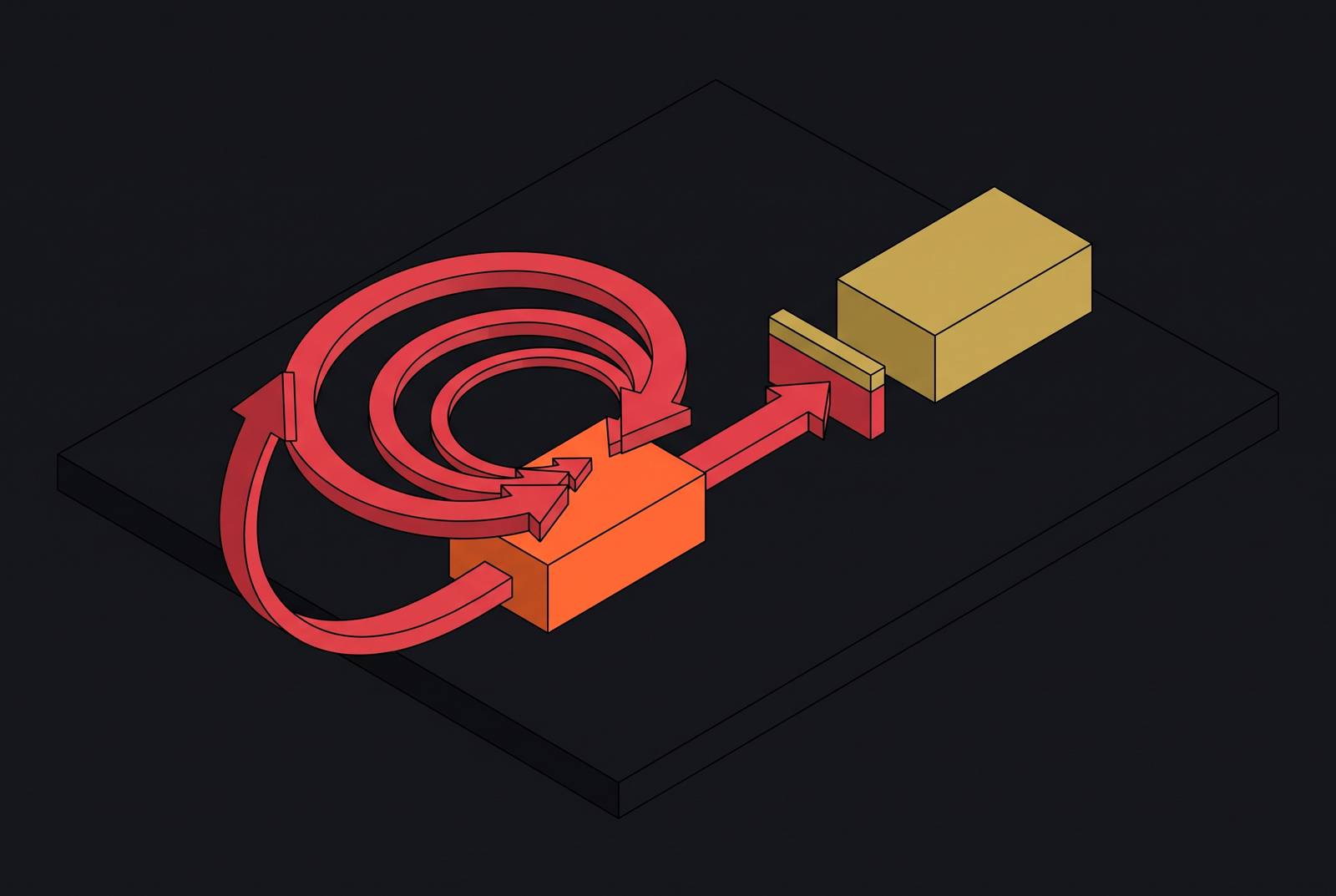
To test retry logic without hitting live rate limits, the test must control both the error and the recovery. Deterministic, locally injected 429 responses provide that control. Injected clocks make client-side timing testable, while stateful simulators reproduce the request sequences that exhaust quota and recover after backoff.
Why live rate limits are the wrong foundation for testing retry behavior
Live rate limits depend on traffic the test cannot control. Requests sent to trigger a 429 use real quota and may draw from the same pool as production users. Parallel CI jobs make this worse because each worker uses capacity shared across the account. Workers that would remain below the limit individually can exhaust it collectively. Competing traffic can therefore cause a failure even when retry logic is correct.
Retries also change the environment being measured. A client that retries too aggressively can extend the rate-limit window, causing more failures and further retries. The behavior under test then worsens the conditions needed to evaluate it. Automatic retries can also hide bad behavior when a response finally succeeds, so a test can pass without showing the faulty timing.
What the test actually needs to verify — and why that requires controlling the 429
A meaningful retry test begins with an explicit policy contract. That contract defines which operations are retryable, the maximum attempts, the elapsed-time budget, the interpretation of Retry-After, and the fallback delay. These expectations must be independent of the current implementation, or the test merely approves whatever the client already does. Once the contract is written down, the required assertions become clear. The test must control the error closely enough to distinguish compliance from eventual success.
For timing, the client must honor the delay specified by Retry-After. Its backoff must remain within the expected jitter range and keep workers from synchronizing on the same delay. For termination, it must cap total attempts and surface a typed error on exhaustion. A circuit breaker must trip after the configured number of consecutive failures. Each assertion requires a known failure sequence.
Workflow correctness adds another requirement. A 429 after a create succeeds but before a confirm completes must leave the system in the correct intermediate state. The test therefore needs control over where the error occurs as well as what it contains. It must also distinguish whether the gateway enforced its limit from whether the SDK slept correctly. Firing traffic until a rate-limit error appears provides a smoke signal, but it does not establish that the client fulfilled its contract.
Why stateless mocks cannot model the request sequence that triggers a rate limit
A stateless mock that always returns 429 can exercise a failure path, but it cannot represent recovery. Rate limiting depends on accumulated requests within a window, so the same request can succeed or fail depending on what happened before it. The essential transition is from available quota to exhausted quota and then back to availability. A fixed response has none of that history. It cannot show that the client waited appropriately and then succeeded because the window reset.
A scripted response at a chosen request position is also insufficient if it is disconnected from prior calls and elapsed time. It can place an error in a sequence without modeling the condition that caused it. That distinction matters when the retry itself changes the request history. The test needs to show whether the next attempt is still rate limited or can now succeed. Otherwise, it verifies a prepared response order rather than the interaction between backoff and recovery.
Multi-step workflows make this limit more visible. A sequence that creates an order, charges a payment, and confirms fulfillment can encounter a 429 after earlier work has succeeded. The test must preserve that work while the client retries the interrupted operation. To verify both recovery and the resulting record state, the test double must remember what existed before the failure. That memory is the relevant difference between a stateless response and a stateful model.
The clock and sleep injection pattern that makes unit-level retry tests fast and deterministic
Client-side timing does not require a server at all. The unit-level pattern is to inject sleep, now, and random as dependencies. Production supplies real implementations, while tests supply deterministic substitutes that record requested delays and resolve immediately. A fake clock makes elapsed time controllable without waiting for a real window to reset. This isolates retry policy from network behavior and removes wall-clock waiting from the test.
Retry-After parsing is a valuable isolated unit within that policy. The parser accepts a header value and the current clock time, then returns a delay in milliseconds. It clamps past dates to zero and rejects malformed input. A fixed clock makes date-relative parsing repeatable because the meaning of the same header no longer changes with the test’s execution time. These assertions can establish parsing correctness without sending any requests.
Backoff calculations need similar control over randomness. Injecting random values fixed at 0, 0.5, and 1.0 lets tests check the expected jitter bounds directly. Attempt numbering deserves a separate assertion because the first network request counts as an attempt before any retries occur. Retry index 0 should not carry a delay, and confusing attempt numbers with retry numbers produces the wrong backoff sequence. Fixed time and fixed randomness make that mistake visible without depending on a live failure.
This layer establishes whether the client calculates and applies its policy correctly. It does not establish whether a server enforces quota or preserves workflow state. A timing assertion should fail because the client requested the wrong delay. Integration tests can then address the interaction that remains.
What a stateful simulator gives the integration test layer that unit tests and stateless mocks cannot
At the integration layer, the local server must count requests across calls and keep the resource state. It must know that requests 1 through N succeeded and that request N+1 should return 429. After the backoff window, request N+2 should return 200 with the correct resource state. Knowing this sequence lets the server’s recovery depend on when the client retries. It also allows the test to inspect the workflow after an interrupted operation succeeds.
Fault injection must therefore be configurable per endpoint and per sequence. The faults include 429s, 503s, and latency spikes, with the rate-limit response set at the point the test needs to check. Requiring code changes for each injected fault makes the simulator unsuitable for repeatable CI use. The same test input must instead produce the same 429 at the same request count on every run. Without that determinism, the replacement inherits the flakiness of the live endpoint.
With realistic seed data, those controlled failures test paths the workflow actually uses. Retrying a failed charge against an existing customer record is different from testing an empty sandbox. The same applies to retrying a failed message send to an existing channel. The simulator must preserve enough state to exercise the actual workflow along with its HTTP response handling. CI must also fail if the simulator does not start, because silently falling back to a live endpoint produces a green result under the wrong conditions.
How specific APIs make local simulation non-negotiable — Stripe, Slack, and Kalshi
Stripe illustrates why a retry test cannot assume uniform response headers. Its rate-limit behavior includes correctly absent headers, so a simulator must include or omit headers such as Retry-After as appropriate. The client’s fallback delay is therefore part of the contract. Stripe also enforces a lower request-per-second ceiling in its sandbox than in live mode, making sandbox thresholds an unreliable stand-in for production conditions. Stripe’s automated testing documentation recommends mock data for error handling and infrequent API requests to validate that responses have not changed.
Slack adds a direct constraint on CI throughput. As of March 3, 2026, non-marketplace commercially distributed apps are limited to 1 request per minute on conversations.history. That ceiling makes live testing of conversation-history retrieval in CI essentially impossible for a suite that must run reliably. For agent developers using this method, local simulation of its rate limits is a requirement.
Kalshi adds variation by account tier. Its docs give rate limits in tokens per second, starting at 200/100 read/write at Basic. Correct client behavior must therefore be tested under different thresholds rather than against one incidental account configuration. Kalshi provides a demo environment with mock funds and separate credentials, but that environment remains shared. It does not remove the quota-sharing and non-determinism that make externally controlled rate limits unsuitable for repeatable tests.
Slack constrains how often the relevant operation can be exercised at all. Kalshi makes coverage depend on more than one quota threshold. Local simulation lets the suite set those conditions itself instead of using whatever conditions the remote environment happens to have.
How simulator drift undermines the value of local testing and how continuous verification prevents it
Determinism is useful only when the simulated behavior remains faithful to the API. The strongest objection to relying on local simulation is the false confidence a silently diverging simulator can produce through green tests against behavior production no longer exhibits. Verify the simulator while retaining control over the test environment.
Continuous probe-based conformance testing provides that verification. Scheduled probes send the same requests to the simulator and the live API, compare the responses, and surface differences as failures. For rate limits, the comparison must cover the threshold, response headers, and recovery schedule. Correctly absent headers matter here too, including Stripe’s case. A simulator that adds helpful headers the real API omits can conceal a broken fallback policy.
This live validation belongs outside routine CI and should run infrequently to avoid consuming quota through repeated checks. Unit tests check the client’s policy with injected clocks, while integration tests check whole sequences against the stateful simulator.
Testing AI agents that call rate-limited APIs — why stateful simulators are mandatory, not optional
Agents intensify the same structural problem because they issue rapid, parallel tool calls with embedded retry loops. A poorly written agent can respond to every 429 by hammering the endpoint without backing off. That is precisely the behavior evaluation needs to catch before the agent reaches a live API. Testing it against shared quota allows the failure being investigated to damage the test environment.
Sandbox access does not solve that problem. Where sandbox limits are lower than production, bursty agent traffic can encounter limits that a human-driven client would not reach. More importantly, evaluation requires the same task to receive the same 429 at the same point in its tool-call sequence. Only then can the result distinguish a change in agent behavior from a change in available quota. A stateful simulator supplies both the repeatable fault and the workflow state in which recovery must occur.
Training loops make that requirement stricter still. RL environments run the same scenario thousands of times across parallel containers, and every run needs the same API state and the same fault injection. Horizontal scalability and deterministic state are therefore necessary parts of the testing foundation. The decisive question remains whether the agent backs off correctly and resumes the interrupted workflow.