Provisioning a Stateful API Test Environment That Mirrors Production Complexity
Integration testing against stateful APIs requires an isolated environment that remembers changes across calls, enforces business rules, and reproduces asynchronous events and failures without touching production data. Tests must exercise ordered workflows. A stateful simulator provides that environment, but its fidelity depends on continuous verification against the live API’s contract and behavior.
Why test environments fail before a single request goes wrong
A green build followed by a production incident exposes a gap between what the tests represent and what production does. Teams automate checks of each endpoint and call the result integration testing, even though those checks never show how upstream and downstream services work in sequence.
The underlying mistake is treating a stateless mock as a sandbox. Creating a user through POST /users does not make that user available through GET /users unless the mock remembers the creation. A hard-coded response can satisfy the second assertion without proving that the first operation changed anything. The test passes, but the workflow remains untested.
This is a modeling error. Distributed systems face time pressure, services that are only partly available, and state that changes across service boundaries. A response generator with no memory cannot show how those interactions work, no matter how closely each of its payloads matches production responses.
What "stateful" actually means for an API test environment
A stateful test environment lets each API call leave a record that later calls can read, change, and check against rules. Redocly’s sandbox guide describes a persistent world where creations, updates, and deletions are remembered during a session. An invoice exists beyond its creation response. It contributes to account totals and can be retrieved later, while deleting it causes a subsequent GET to return 404.
A balance-affecting operation changes the available balance, and a later deduction fails when funds are insufficient. This distinguishes stored fixtures from an executable model of the service. Remembering an object is necessary, but remembering it without enforcing its consequences is incomplete.
Service virtualization occupies the space between static responses and a full sandbox. It can maintain session state, enforce rules, and reproduce latency, timeouts, or malformed responses, making it useful for negative testing. A full sandbox also supports destructive actions and asynchronous workflows. For a payment integration, the immediate HTTP response is only part of the exchange because critical information may arrive through a webhook.
Authentication belongs inside this model of correctness. If production uses OAuth 2.0 with token expiry, the test environment must use the same method and expiry schedule. Otherwise, even a workflow with accurate balances and webhooks leaves token-expiration handling untested.
The two isolation architectures and the drift problem each creates
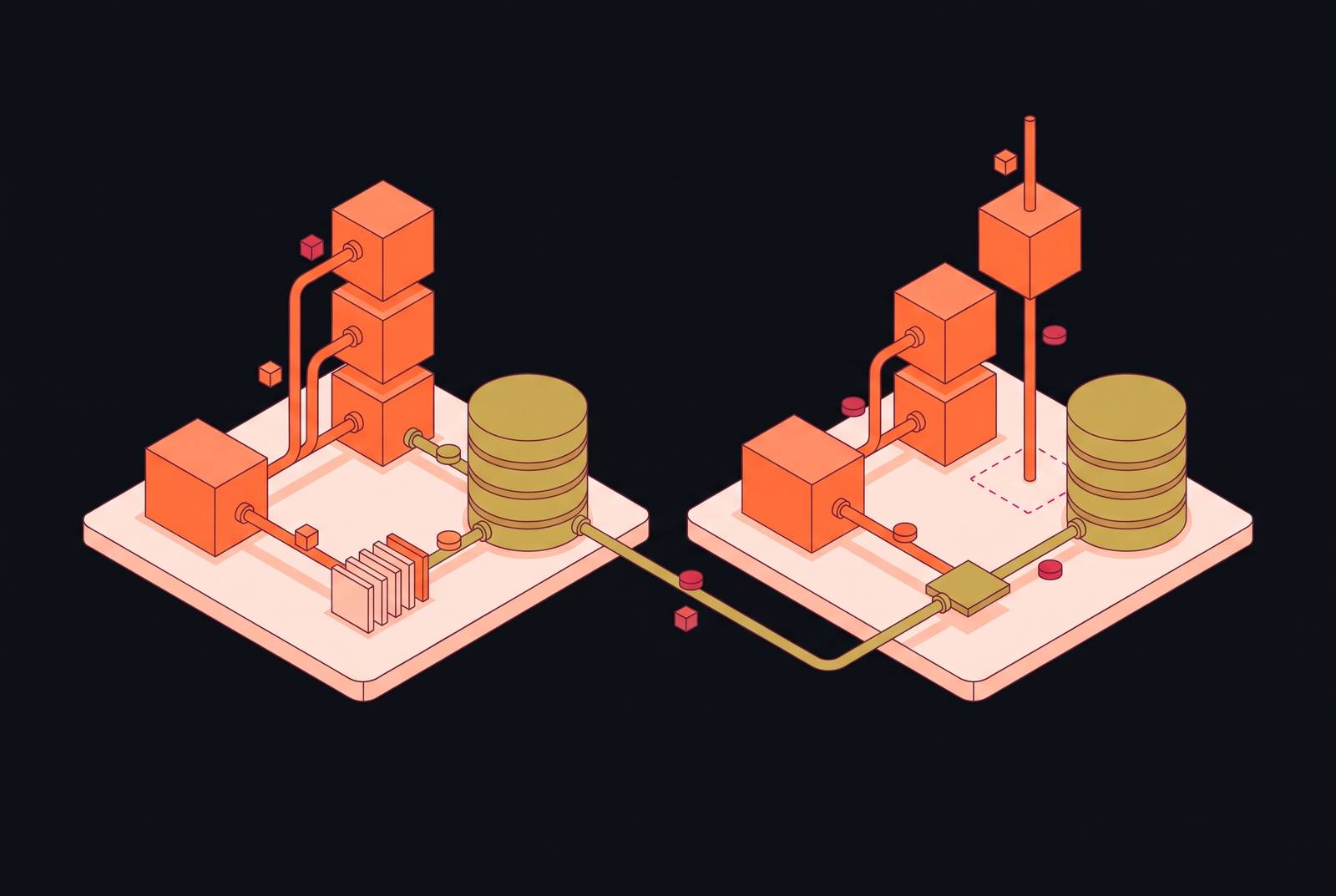
Logical isolation places the sandbox on shared infrastructure and separates it through test-mode API keys. The sandbox guide describes how to send test data to separate tables or mark records as is_test. This keeps infrastructure overhead low and keeps the code in line with production. However, a query bug can include test data in production reports, and test emails can reach real customers.
With physical isolation, the sandbox has its own stack that can be reset without touching production data. It provides a harder boundary. Stripe’s API keys documentation establishes that objects in one mode are inaccessible to the other, so a sandbox product object cannot become part of a live payment. For high-stakes domains such as fintech, preventing contamination is the reason to favor physical separation.
That separation creates a different maintenance obligation. An independent environment can lag behind production in version, endpoint coverage, settings, or behavior. Stripe’s sandbox documentation explicitly acknowledges that settings and capabilities are not synchronized with live and can diverge.
Logical isolation needs protection against contamination, while physical isolation needs protection against drift. The guide recommends treating the sandbox as a production-grade product with contract tests, deploying there first, and promoting only when behavior matches the specification.
What real API drift looks like across Stripe, PayPal, Kalshi, Slack, and GitHub
Stripe illustrates why matching endpoints is not enough. Event order is not guaranteed, duplicate deliveries can occur, and live delivery retries continue for up to three days. Sandbox events receive only three retries over a few hours. Stripe also excludes IC+ pricing from sandbox testing, leaving a capability gap that test code cannot remove.
PayPal’s sandbox guide states that it “has the same PayPal API feature set as the live environment.” Its webhook simulator has a narrower role. PayPal’s simulator documentation says generated events are for demonstration, are not associated with an App, and do not appear in the dashboard event viewer. Failed live deliveries are retried multiple times over several days, so demonstration events alone cannot establish retry-handling correctness.
Kalshi exposes a separate configuration concern through its environment addresses. Its sandbox is at external-api.demo.kalshi.co/trade-api/v2, while production is at external-api.kalshi.com/trade-api/v2. The destination therefore changes between environments. This is a configuration boundary rather than evidence, by itself, of a behavioral defect.
Issue #104 on slack-edge/slack-web-api-client records an automated drift check dated September 28, 2026, comparing the Slack changelog, Java SDK, and slack-edge. The check identified blocks.validate in the Java SDK but missing from api-client.ts. The gap was in the client’s coverage.
GitHub provides a public contract against which such gaps can be measured. Its public OpenAPI description was a live artifact as of mid-2026 and serves as a drift target for third-party SDK maintainers. These examples concern different layers of fidelity. Delivery semantics, environment configuration, capability limits, and client mappings all affect whether a passing integration test predicts production behavior.
Shared staging environments and the contamination they cause in CI
Even an API simulator that gets the behavior right can give results that cannot be trusted when unrelated tests share its state. Two teams or pull requests running against the same staging instance can alter records that the other expects to remain unchanged. A deployment during a test run can change the environment again. The resulting failure belongs to the test setup, yet engineers must still triage it.
Feature flags can cause contamination through differences in configuration. A test may target a flag-enabled path in staging while QA has the flag disabled and production has a partial rollout. That mismatch can produce schema differences and false failures. A fresh database does not resolve it. Before tests run, a flag-drift check must compare how the flags are set in each environment.
For teams in this position, the recommended approach is an ephemeral environment for each pull request, provisioned through Docker Compose, Kubernetes namespaces, or managed preview environments and removed when the pull request closes. Each environment starts with known state and accumulates changes only from its own run.
The initial state must also be useful. With realistic transactions and active resources, developers can test useful workflows without first having to build a whole test world. For automated assertions, deterministic “magic inputs” are more valuable than random realism because they produce predictable outcomes. Reproducibility depends on both an isolated world and a known starting point.
Fault injection as a first-class requirement, not an advanced feature
A stateful environment that represents only successful behavior leaves resilience untested. Failure handling needs to be tested in the same environment as functional testing because retries, deadlines, and recovery happen within workflows that have already changed state. A successful creation followed by a failed downstream call is not equivalent to an isolated error response. The sequence provides the context for the failure.
An audit of the environment needs to cover five types of fault injection. Connection refusal tests graceful failure rather than hanging, while latency injection exercises timeouts and deadline propagation. Protocol corruption, including malformed JSON or the wrong content type, targets parsing and validation. Availability simulation through 429, 503, and 504 responses exercises backoff, retries, and circuit breakers. Semantic corruption uses valid JSON with impossible values to test domain validation.
Rate limiting deserves explicit coverage in API-dependent software. A client that never encounters 429 during testing has not demonstrated correct backoff or handling of server-specified retry delays, both integration requirements. CI tooling options include Istio’s fault injection, the Grafana xk6-disruptor extension for k6, Chaos Mesh, and Gremlin. SequenceFI introduces a non-intrusive temporal fault-injection framework evaluated on four microservice benchmarks.
Broken authorization, token replay, and unexpected access paths can emerge when real users, roles, and request sequences interact with a live service. One injected fault cannot cover all those combinations. Runtime corroboration and post-deployment monitoring remain necessary even when pre-deployment resilience tests pass.
Testing AI agents requires the same stateful environment properties, with higher stakes
An AI agent can produce coherent text while sending a malformed or semantically wrong API call. Fluency does not establish tool-call correctness. Evaluating only the final response misses errors in parameter extraction, endpoint selection, and response parsing. Tests of an agent must check the call itself and what the agent does with the result.
State becomes essential when the workflow spans turns. An agent that creates a resource in turn 1 and queries it in turn 3 needs the environment to remember the creation. Static responses can make each turn appear plausible while concealing a broken sequence, just as independent endpoint assertions can conceal a broken application integration.
Amazon’s Strands Evals team provides ToolSimulator for this problem. It intercepts tool calls and routes them to an LLM-based response generator that uses the tool schema, user parameters, and current simulation state. This avoids live calls that could expose PII or trigger unintended actions.
Agent testing adds a stricter requirement of indistinguishability. The sandbox must be proxied so the agent cannot distinguish it from the intended API or MCP endpoint, because detectable differences can change behavior and undermine prediction. Reinforcement learning needs the same controllable, repeatable state at training scale. An environment that drifts, requires live credentials, or imposes external rate limits cannot provide that foundation across thousands of containers.
Why continuous verification against the live API is the only way to keep fidelity honest
Fidelity is an ongoing engineering obligation. New fields, changed error codes, different event delivery, and new rate-limit headers can all open gaps between a simulator and its upstream API. Isolation does not prevent those gaps. Without verification, a clean, repeatable environment can become a reliable way to test obsolete behavior.
The verification discipline combines nightly contract diffs against upstream OpenAPI or AsyncAPI specifications with attention to the live behavior those contracts represent. Contract comparisons expose endpoint and response-shape gaps, while webhook timing, authentication expiry, and business rules remain behavioral requirements. With sandbox-first deployment, those checks help control what gets released.
Contract failures must still be able to stop a change. Autonomous AI repair is dangerous here because a failing assertion may be the only warning that an API change breaks the integration. A test that rewrites its expectations to accept whatever now arrives no longer detects that break. AI assistance can generate scaffolding, but changing contract assertions automatically defeats their purpose.
Published, continuously updated fidelity scores make verification claims auditable. The methodology must show which behaviors are tested and which remain approximations, rather than presenting fidelity as an unsupported assurance. That evidence gives teams a basis for deciding what their passing tests actually establish. It also shows where the gaps are before teams assume those behaviors will work in production.
With this discipline, the simulator can support sequential calls, enforce balance checks and order transitions, and exercise webhook delivery or token expiry without live credentials or a rate-limit budget. Local and CI runs can operate without network dependencies, including in offline or air-gapped environments. Developers can validate how an application or agent changes the world across calls without risking the production world it will eventually use.