Integration Testing Stripe Payment Flows End-to-End
Stateful tests catch the webhook, decline, and retry bugs that API checks miss.
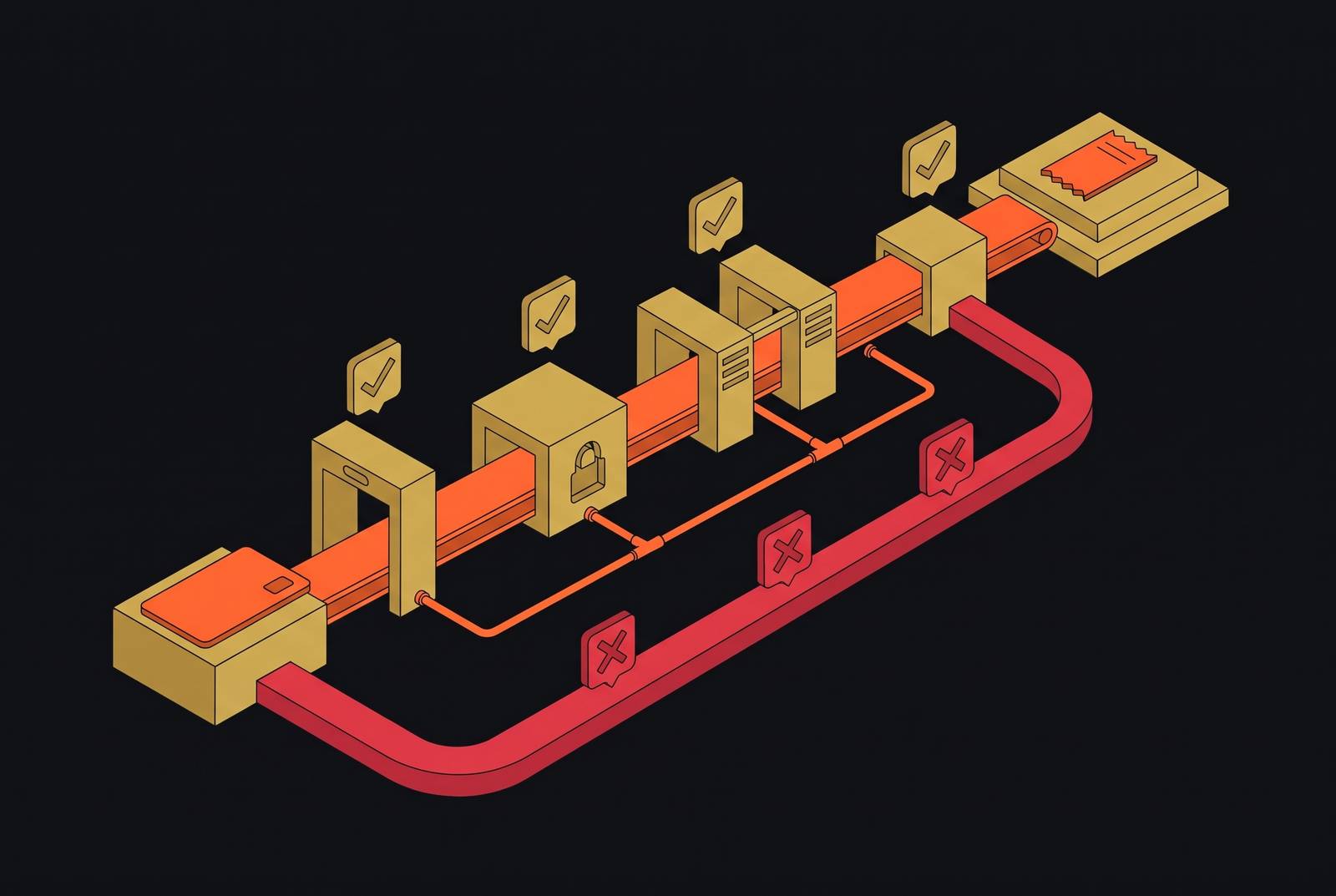
To integration-test stateful APIs without hitting production, run ordered calls against an isolated test environment that preserves state, then verify their cumulative effects in the application. For Stripe, end-to-end coverage means exercising PaymentIntent transitions, webhook delivery, declines, and billing lifecycles. A locally hosted, stateful simulator makes those flows deterministic in CI, while Stripe’s native test infrastructure provides high-fidelity verification.
Why Stripe payment flows break in integration testing even when the API calls are correct
A checkout shows “Payment successful,” but the customer’s account stays locked. The payment succeeded. Fulfillment did not. The app depends on a webhook that it may never have received or handled correctly, so a correct API response proves only part of the purchase worked.
That gap is the central integration failure. Checkout creates a PaymentIntent, receives a synchronous response, and depends on asynchronous delivery to fulfill the order. Each step changes what the application should do next. Declines show the same weakness when a failed payment leaves a broken page instead of an error message, while duplicate or out-of-order webhooks reveal handlers that expect every event to arrive once and in order.
What a stateful test must actually track across a Stripe payment flow
An end-to-end test proves that sequential operations produce the correct cumulative result. Relevant objects include Customer, PaymentMethod, PaymentIntent, CheckoutSession, Subscription, and Invoice. Their significance is not their individual response shapes but how state accumulates across calls.
For every purchase, the test must verify that Stripe reflects the correct payment result, the application records it against the correct account, and reopening the app shows the access earned. Nothing more should become available. Shipping must wait for success, retries must not double-charge, and concurrent upgrade and downgrade operations must not corrupt subscription state. Stripe’s testing documentation also warns that card-level state can affect later tests using the same card, making isolation part of correctness.
Stripe's native test infrastructure: what it covers and where it stops
Stripe’s test cards cover payment branches: 4242 4242 4242 4242 succeeds, 4000 0000 0000 9995 gives an insufficient-funds decline, and 4000 0000 0000 0002 gives a generic decline to check that the UI recovers and access stays blocked. Authentication needs a separate path. 4000 0027 6000 3184 requires 3D Secure authentication on every transaction, then succeeds, while 4000 0000 0000 0259 produces an asynchronous fraudulent dispute after payment succeeds.
Stripe’s test clocks advance billing time by days or months without waiting for real time. They support renewal, dunning, and cancellation tests, but browser authentication needs different machinery. The SCA modal is an iframe, so Playwright or Cypress must drive it. Native test mode still runs on live infrastructure that has rate limits and needs credentials. Shared mutable data, webhook timing assumptions, and uncontrolled delivery order therefore remain constraints for CI.
How do you test APIs where order of operations matters?
A stateless mock returns a fixed response for a matching request. It does not remember what happened before. If checkout needs the transaction ID generated by an earlier creation call, the second response must depend on the first operation’s side effect.
A stateful simulation instead preserves objects and applies transitions as calls arrive. Creating, retrieving, and confirming a PaymentIntent must expose status changes such as requires_payment_method, requires_confirmation, and succeeded in the appropriate sequence. The same requirement extends to billing. Replacing a payment method with 4000 0000 0000 0341 and advancing time must produce the failed-renewal result following the initial success. Webhooks must follow those changes, so confirmation can produce payment_intent.succeeded and a failed renewal can produce invoice.payment_failed. Duplicate delivery must then exercise the application’s one-action-only behavior.
How available tools sit on the stateful-to-stateless spectrum for Stripe testing
WireMock Cloud supports stateful scenarios that remember earlier requests and outbound webhooks for asynchronous callbacks. That suits ordered flows and authentication handshakes. MSW serves a different layer, running in-process in Node.js and through a Service Worker in the browser. It works for frontend component testing, but test authors must manage state themselves, and that state does not carry over across process boundaries in a CI container.
Stripe’s own test mode is fully stateful and high-fidelity, making it the strongest option for manual verification and interactive testing. CI introduces a different set of requirements. A stateful simulator that runs locally and is checked continuously against the live Stripe API takes live credentials and rate limits out of that loop. These simulators work in offline and air-gapped environments, can start with realistic data already in place, and support fault injection. The selection criteria are therefore response matching, state persistence, webhook causality, API fidelity, isolation, and control over failures.
Testing the PaymentIntent lifecycle: the state machine a test suite must drive
The PaymentIntent suite should create the payment, attach a payment method, and then drive confirmation before it reaches success. Sequence is the test’s essential input. The ordinary path moves through requires_payment_method and requires_confirmation to succeeded, while authentication takes requires_confirmation to requires_action. Browser automation completes the challenge before the test verifies success.
Failure coverage must distinguish a decline with an error and no access from a canceled payment. An abandoned payment tests canceled, while a declined payment must still allow a retry. After success, the dispute card exercises a separate dispute event. A network-timeout retry must also reuse the idempotency key and return the original PaymentIntent. Fulfillment then needs its own assertion because client-side confirmation or a redirect cannot substitute for the payment_intent.succeeded webhook, especially if the customer closes the tab.
Testing webhook delivery: the async layer that fulfillment depends on
For one-time payments, payment_intent.succeeded drives fulfillment, while Stripe Checkout uses checkout.session.completed with fulfillment independent of the redirect URL. Delayed payment methods also require checkout.session.async_payment_succeeded and checkout.session.async_payment_failed. Subscription handlers cover invoice.paid, invoice.payment_failed, customer.subscription.updated, and customer.subscription.deleted. Each event needs a business-effect assertion.
Delivery behavior needs independent coverage as well. Normal delivery must act once, duplicate event IDs must not repeat the action, and stale events must not reverse newer decisions. Signature verification adds a security boundary, so valid-path tests need valid test signatures, while unsigned and tampered payloads must be rejected. Stripe’s live-mode delivery retries can extend to 72 hours, making recovery after handler failure another required case.
Local testing can use stripe listen and stripe trigger, with the listener running in the background and a startup delay before triggering. Specific past events use stripe events resend. A stateful simulator that emits events from API transitions removes that listener dependency and gives CI direct control over duplicates and ordering.
Testing subscription and billing lifecycle transitions
Subscription tests must control time because failed renewals, access revocation, and proration errors emerge across billing cycles. Initial checkout is not enough evidence. The test-clock workflow creates a clock, attaches a subscription, and advances time to the relevant boundary. Trial completion should move trialing to active and generate the first charge, while successful renewal should emit invoice.paid and preserve access.
The decisive negative case starts with a successful subscription, replaces the customer’s payment method with 4000 0000 0000 0341, and advances the clock. The test must verify invoice.payment_failed, scheduled dunning retries, customer notification, and eventual access revocation. Tests of mid-cycle plan changes must also check proration and that subscription items stay intact when upgrades and downgrades happen in quick succession. Cancellation must end access at the correct period boundary, while usage-based billing must test reporting before invoice finalization and quantity tampering before that boundary. Test clocks still require live Stripe credentials, so controlling time does not remove CI’s external dependency.
Building a CI pipeline that tests Stripe flows deterministically
Unit tests run on every commit without network calls and check how the code handles declines and idempotency. Contract and API tests run on every pull request and check against the pinned API version. Full integration tests run when code is merged to main, deployment smoke tests check that webhooks can be reached and are signed, and longer end-to-end and load tests run with fault injection each night or before a release. Each layer answers a different correctness question.
In integration tests, every scenario must start from a state known to be clean. Async assertions should poll for conditions instead of relying on fixed sleeps, and uncontrolled external boundaries should be mocked or simulated. Stripe CLI fixtures provide repeatable setup but still need a live connection. A containerized stateful simulator replaces that dependency and can scale across CI workers without live credentials or rate limits.
Secret test keys begin with sk_test_, and any sk_live_ value in CI must stop the pipeline immediately. Keys belong in a secrets vault or environment variable store and must never be committed as part of the configuration. Stripe’s upgrade guidance also recommends specifying the API version in code, so SDK initialization should override the account default by setting apiVersion.
Fault injection: testing what happens when Stripe behaves badly
Fault tests must interrupt real sequences. A timeout after an operation begins poses a different question from a failure before anything changes. Latency tests must check that slow responses do not cause double submission, while HTTP 429 tests must verify backoff and reuse of idempotency keys. HTTP 503 webhook failures must exercise eventual recovery and one-time processing after delivery resumes.
Partial or malformed HTTP 200 responses can leave missing or corrupted fields without a latency or status-code warning, and schema drift must not pass unnoticed. Billing adds timing-dependent faults such as proration errors and rapid upgrade and downgrade races. These cases require the simulator to preserve the PaymentIntent or subscription state that existed before the fault. Otherwise, a mocked 429 tests an error branch without testing recovery from the interrupted transaction.
Applying the same stateful testing discipline to AI agents that call Stripe
Agents can generate Stripe call sequences that no developer explicitly planned. An agent might create a Customer, attach a PaymentMethod, create a Subscription, then cancel and re-subscribe within one session. Every later call depends on earlier effects. Stateless responses cannot follow that sequence, while live test-mode rate limits constrain training and evaluation at scale.
Fault injection is particularly useful when agents receive empty or truncated content with an otherwise normal HTTP 200 response. Status and latency telemetry do not reveal that corruption. Agent Reliability Lab demonstrated in a trial run that hardened agents outperformed baseline agents on task completion and reduced hard safety violations to zero. Reinforcement learning environments for Stripe tool use also need deterministic, controllable state that scales across training containers, which favors locally hosted simulation over live sandboxes.
What a complete Stripe integration test suite looks like in practice
Payment tests should follow a payment from creation through confirmation, receipt of the webhook, and the grant of access. Declines must show an error without granting access, 3DS must complete through the browser, and disputes must reach their own handler and internal alert. Retrying creation with the same idempotency key must return the original PaymentIntent. The application’s final state is the decisive assertion.
Webhook coverage should verify normal, duplicate, stale, unsigned, tampered, and delayed delivery after recovery. Billing coverage should drive trial completion, successful renewal, failed renewal with dunning, prorated plan changes, and cancellation at the correct boundary. Resilience coverage should interrupt those flows with latency, rate limits, service unavailability, and malformed successful responses. Each independent scenario needs a clean context, with a different test card where card-level state affects isolation or a fresh simulator context. Completeness comes from proving what each transition permits next.