When Third-Party Session State Breaks Your Integration Tests and How to Regain Control
Use a continuously verified local simulator to reset state between tests and catch API changes.
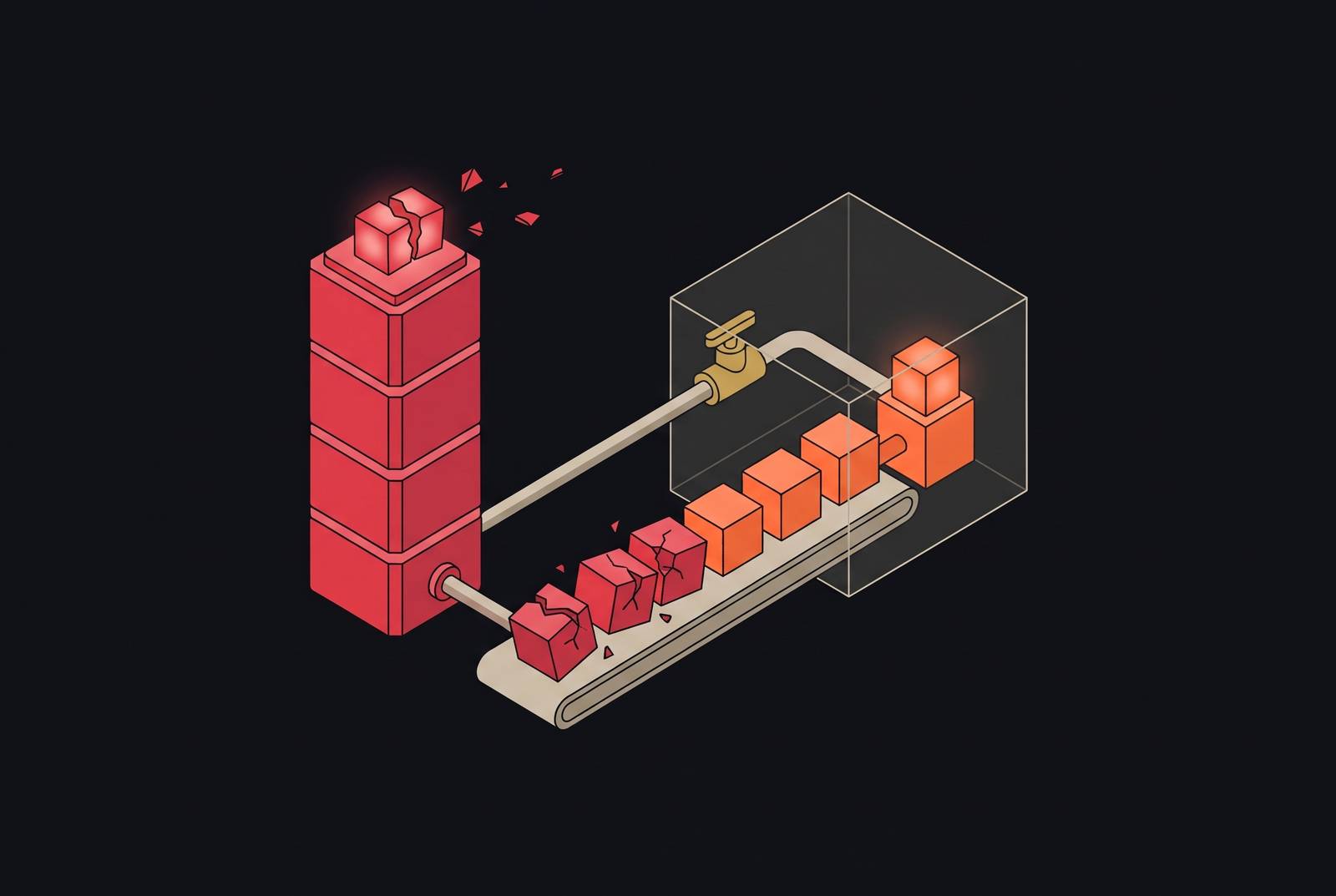
Integration testing against stateful APIs needs a stateful stand-in that the team owns locally and can seed, inspect, and tear down between runs. Third-party session state breaks tests because external services remember earlier calls, but the test suite cannot reset their world. A continuously verified simulator restores control without hitting production, while preserving the cumulative behavior that static responses cannot test.
Why integration tests that cross real API boundaries are fundamentally different from unit tests
A unit test can isolate a deterministic function and replace its collaborators with controlled responses. An integration test has a different purpose. It tests the interfaces and interactions between components, including the data exchanged, the contracts each side assumes, and the effects of running them together. Crossing a real boundary introduces timing and configuration that the test may not control, whether the dependency is a database, a message queue, or a third-party API.
That difference changes what a failure means. A failed assertion can expose an application defect, but it can also reflect a dependency behaving differently from the environment the test expected. Third-party downtime, rate limits, and sandbox quirks add causes unrelated to the code under test. Even when every request succeeds, earlier calls can change later results through the dependency’s state.
How external state accumulates across API calls and why your test suite never resets it
Consider a test that creates a Stripe customer, lists customers, and then deletes the customer. The creation changes the provider’s stored data, and the list request reads from that changed world. Deletion is another API operation within the existing environment. If the test stops before deletion, a later run can find the customer it left behind.
The same mechanism extends beyond created records. Cookies, logged-in sessions, feature flags, and cached data can change what the next request sees without any change to application code. A suite can clean up the objects it knows about, but that is not equivalent to restoring the entire service to a known baseline. Its lifecycle and the provider’s lifecycle are separate.
Concurrency makes that separation harder to ignore. When tests share external state, a call from one workflow can alter the conditions another workflow is checking. A session-expiry check can therefore succeed in isolation yet race to a wrong result when services run together.
Why test order-dependence is the symptom and uncontrolled state is the disease
A test that passes alone but fails after another test is exposing a hidden precondition. It may require the absence of a record the earlier test created, or depend on data that another test was supposed to remove. The order is revealing an existing dependency. Changing the order in which tests run can move the failure without fixing what caused it.
Retries and sleep statements do not restore that precondition. Increasing a timeout may accommodate a slow response, but it cannot make accumulated data disappear. Shuffling test order can help reveal leakage, yet the suite remains non-deterministic until each test controls its starting state. A shared, persistent mock server can reproduce the same problem as a live sandbox if nobody resets it.
The corrective discipline is to generate isolated data per test, reset state between runs, and never depend on leftovers. Local hosting alone is insufficient. Ownership means being able to establish and restore the conditions that determine the result.
What stateless mocks get right and where they fail once a workflow has memory
Stateless mocks remove a real source of uncertainty. By matching request patterns to predefined responses, they make checks fast and stable without needing the external service to be up. They are appropriate for unit tests and simple request-and-response checks. A consumer’s handling of a particular response can be tested without recreating the provider’s internal world.
The boundary appears when the workflow has memory. A stub that returns the same order for every GET /orders/42 cannot demonstrate that creating, fetching, cancelling, and fetching the order again produces the required status change. Configuring a different response for the final fetch can make the sequence look correct. It does not establish that cancellation caused the change.
That distinction is essential when application logic branches on prior operations. The responses in a predefined sequence can agree with each other even when the application’s transitions are wrong. Hand-maintained stubs also need someone to update them when the real API changes, so tests can keep passing while the contract is out of date.
What a stateful simulator actually does that a mock cannot
A stateful simulator maintains a local world across requests and executes the behavior that changes it. Creating an invoice makes that invoice available for retrieval and contributes to account totals. Cancelling it changes what a later fetch returns.
The simulator remembers within a workflow, while the test controls when that memory is discarded. Running locally means tests can run without live credentials or an external network connection and are free of provider rate limits. It also gives the suite a reset lever that a remote provider does not expose for its entire environment.
Realistic pre-seeded data makes this control useful for tests that need more than an empty world. Records, messages, and transactions can provide the starting conditions a workflow needs without requiring every test to construct them from scratch. But control is only one requirement. The simulator’s behavior also needs to be checked continuously against the real API.
How simulator drift silently undermines the confidence stateful testing is supposed to provide
A simulator can be perfectly repeatable and still be wrong. If it omits an operation or retains behavior the provider has changed, passing tests establish compatibility with the simulator, leaving compatibility with production unverified. This is the strongest limitation of local simulation.
An automated fidelity tool reported a missing Slack admin.conversations.kick operation that the vendor documented but the simulator did not serve. Behavioral divergence can be subtler, such as an outcome.type difference for EU Stripe transactions. A simulator that misses that difference can preserve an assumption the live service no longer supports.
To catch these gaps, the simulator should be checked against the real API on an ongoing basis and before every release. Published fidelity scores provide evidence for judging how closely its behavior matches the provider. Checking the simulator is part of keeping it up to date, and passing those checks when it was first built gives no one-time certification.
How can you do integration testing against stateful APIs with seed, run, inspect, and tear down?
The practical workflow begins by seeding exact preconditions before each test. Load the records, account state, and history needed for the scenario, rather than accepting whatever a previous run left behind. The baseline must be known and repeatable. For parallel tests, isolation must also prevent one workflow from modifying another’s starting world.
Next, run the application’s full workflow against the simulator. Exercise the relevant sequence of creation, retrieval, modification, and deletion so that later calls depend on the effects of earlier ones. Then inspect the resulting state directly. Response codes alone cannot show whether the application created the right record, changed its status, or removed what it was supposed to remove.
Finally, tear down the test’s world completely. Reset to a clean baseline or load the next test’s seed before residual state can influence another result. In test structure, setup establishes the world, the test exercises and inspects it, and cleanup restores control. This pattern complements real dependencies for infrastructure the team owns and can start, including its database and message broker.
Fault injection as a first-class part of integration testing, not an afterthought
Owning the simulated world also makes failure conditions controllable. A live API cannot reliably provide a 503 response or a three-second delay exactly when a test needs one. A simulator can inject latency, rate-limit errors, and partial failures at a chosen point in a workflow. The test can then inspect what happened to state after the failure and check that an error handler ran.
Payment webhooks make this requirement concrete. Stripe retries undelivered webhooks for up to three days, while PayPal requires HTTP 2xx acknowledgments and can retry many times over three days. Integration scenarios therefore need events that are delayed, are duplicates, or arrive out of order. Replaying those sequences tests acknowledgment behavior without waiting for the provider’s delivery schedule.
Asynchronous behavior needs an explicit test gate. Forcing an event to fire immediately avoids making CI wait for a sandbox cron job. The same control becomes important for agents using APIs as tools, where a timeout, a 429, or semantically corrupted data can alter the agent’s next action.
Why AI agents that call external APIs face a strict superset of these same state problems
An LLM agent inherits the application’s external-state problems and adds non-deterministic behavior of its own. If both the caller and its environment vary, a changed outcome becomes harder to diagnose. A benchmark that assumes every tool works leaves this interaction untested. Successful requests are not sufficient either, because structurally valid responses can contain stale or semantically wrong records.
The same testing vocabulary applies without modification. Seed a known tool environment, run the agent, inspect the resulting state, and tear down the environment before the next evaluation. For fault injection, hold the other tool responses constant while perturbing one with a known fault. Re-running that fault after a mitigation creates a controlled comparison, although the agent itself may still vary.
Reinforcement learning increases the isolation requirement further. Training can require thousands of parallel rollouts, each with an independently resettable API world. A shared live sandbox cannot supply those independent environments. A stateful simulator that scales horizontally across containers can provide the controlled state each rollout needs without making the agent’s behavior deterministic by assumption.
Applying local stateful control to specific APIs, including Slack, GitHub, Stripe, Kalshi, PayPal, and others
The appropriate simulator depends on the state the application uses. For Slack, channel membership, message history, and admin operations must agree with each other from one call to the next. For GitHub, repository state, pull request lifecycle, check runs, and webhook delivery form the workflow. A test that creates a pull request, reviews it, and merges it needs each operation to act on the result of the preceding step. Independent canned responses cannot establish that relationship.
Stripe workflows span customers, invoices, payment intents, and webhook retries, so the simulator must track those pieces together. PayPal tests need replayable webhook retry sequences to exercise acknowledgment logic before production traffic reaches the handler. Endpoint availability is only the starting point. The useful criterion is whether the simulator preserves the relationships the application depends on.
Kalshi integrations need recorded market state and order book depth for tests of order-placement and settlement to be useful. Resend’s transactional email workflows and Lob’s mailing workflows instead involve delivery status callbacks and state updates. For both, webhook replay and direct state inspection apply the same control pattern to a different lifecycle.
The CI/CD implications of owning your API state, and what changes when tests are deterministic
Deterministic integration tests change what can serve as a dependable pipeline gate. State-transition checks, webhook replay, and fault injection can run on every commit without needing the third party to be up or leaving records behind in a shared sandbox. A failure becomes more useful because the starting conditions are known. The pipeline spends less effort distinguishing code defects from an environment that changed underneath the test.
Contract tests and continuous comparison with the real API address drift, while the application’s integration suite runs against controlled local state. The recommended architecture uses real dependencies for infrastructure the team owns, verified stateful simulators for third-party APIs, and a small set of live smoke tests that run on a schedule. Those live checks provide a final sanity check outside the primary CI gate.
Running locally also lets tests run on offline laptops, in air-gapped enterprise environments, and in parallel training loops. These are consequences of removing the live provider from the test’s immediate execution path. Owning state is therefore a structural decision about where integration tests get their signal. Unit tests gain determinism by controlling their collaborators, and stateful integration tests extend that control to the third-party world their workflows depend on.